What Is Digital Marketing? 9 Powerful Channels Explained (2026)
What Is Digital Marketing?
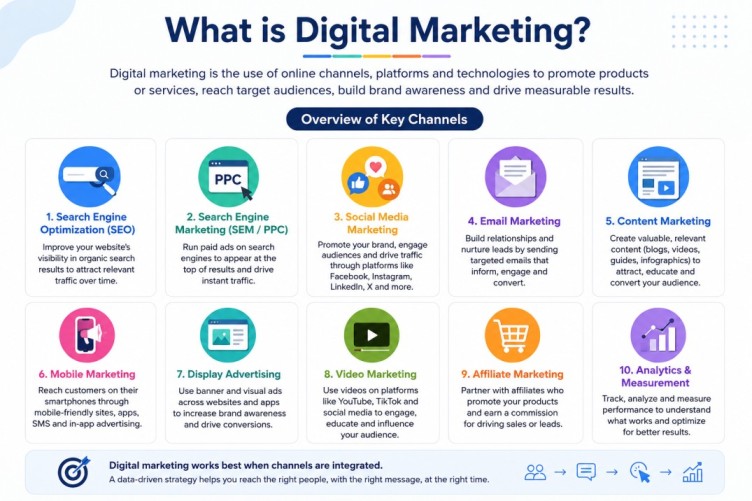
Digital marketing is the promotion of products, services, or brands through digital channels and internet-connected devices. It covers everything from appearing in Google Search results and running ads on Instagram to sending email newsletters, publishing blog posts, and creating YouTube videos.
At its core, digital marketing is about reaching the right person, with the right message, at the right time — using the internet as the medium.
Unlike traditional marketing that relies on physical channels (TV, radio, print), digital marketing is measurable, targeted, and adjustable in real time. You can see exactly how many people clicked your ad, visited your page, or bought your product — and you can change your approach mid-campaign without wasting money on already-printed flyers or booked airtime.
Simple definition: Digital marketing = any marketing effort that uses the internet or an electronic device.
Whether you’re a small business owner in Kathmandu trying to reach local customers, a global e-commerce brand selling to 50 countries, or a freelancer building a personal brand — digital marketing is the engine that drives online growth.
Why Digital Marketing Matters More Than Ever
Over 5.4 billion people use the internet today. Your customers are online — searching Google, scrolling Instagram, reading emails, and watching YouTube. If your business isn’t showing up where they spend time, competitors who are will win those customers instead.
Here’s why digital marketing is no longer optional in 2026:
Massive reach at low cost. A blog post you publish today can attract organic traffic for years without recurring costs. A well-targeted Facebook ad can reach thousands of people for a few dollars.
Precise audience targeting. Google Ads and Meta Ads let you target by age, location, interests, income, job title, behavior, and even what competitors’ products people have been researching. Traditional TV ads can’t do that.
Measurable ROI. Google Analytics 4 and platform dashboards show you exactly what’s working. You know your cost per click, cost per lead, and cost per sale — down to the channel, campaign, and even individual keyword.
Leveled playing field. A startup with a smart SEO strategy can outrank an established corporation. Content quality and relevance matter more than ad budget alone.
Consumer behavior has shifted permanently. More than 90% of purchase decisions now begin with an online search. Whether customers are buying software, shoes, or a local service, they research online first.
How Digital Marketing Works
Digital marketing works by creating a system that attracts strangers, converts them into leads, and nurtures them into customers and advocates. Here’s the simplified flow:
- Attract — People discover your brand through Google Search, a social media post, a YouTube video, or a referral link.
- Engage — They visit your website or landing page, read your content, or interact with your brand on social media.
- Convert — A compelling offer, form, or call-to-action turns a visitor into a lead (email subscriber, free trial signup, quote request).
- Nurture — Email marketing, retargeting ads, and content keep the lead engaged until they’re ready to buy.
- Close — The lead makes a purchase.
- Retain & Advocate — Post-purchase emails, loyalty programs, and exceptional service turn customers into repeat buyers who refer others.
This entire journey is tracked using tools like Google Analytics 4, CRM systems (like HubSpot or Salesforce), and ad platform dashboards — giving you data to optimize every stage.
Understanding the Digital Marketing Funnel
The marketing funnel maps the stages a customer moves through before buying. Understanding it prevents the most common mistake in digital marketing: pushing sales messages at people who aren’t ready yet.
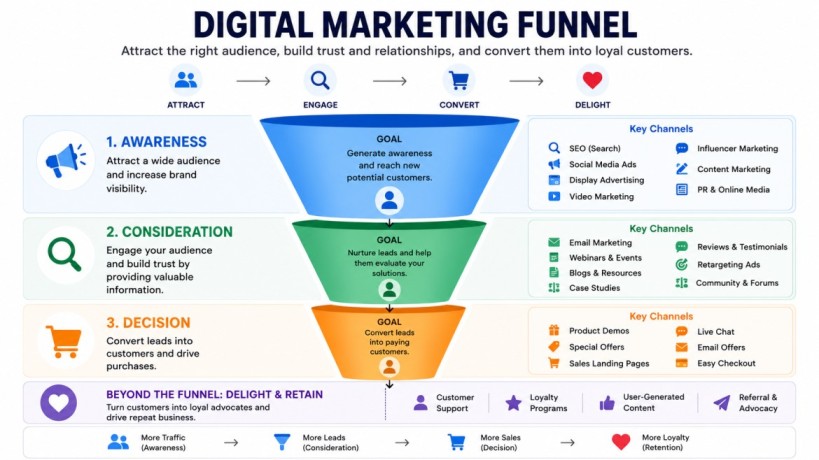
Top of Funnel (TOFU) — Awareness The prospect doesn’t know your brand yet. Your goal is visibility and education.
- Channels: SEO blog content, social media posts, YouTube videos, display ads
- Example content: “What is email marketing?” or “5 signs your website needs SEO”
Middle of Funnel (MOFU) — Consideration The prospect knows their problem and is evaluating solutions. Your goal is to build trust.
- Channels: Email nurture sequences, case studies, webinars, comparison articles
- Example content: “HubSpot vs Mailchimp: Which email tool is right for you?”
Bottom of Funnel (BOFU) — Decision The prospect is ready to buy. Your goal is to remove friction and close.
- Channels: PPC ads, retargeting, landing pages, testimonials, free trials, demos
- Example content: “Start your free 14-day trial” or “Get a custom quote today”
Post-Funnel — Retention & Advocacy Existing customers are your most valuable asset. Your goal is loyalty and referrals.
- Channels: Email marketing, loyalty programs, community building, review requests
Most businesses focus too heavily on BOFU and ignore the awareness stages. Smart digital marketing builds the full funnel.
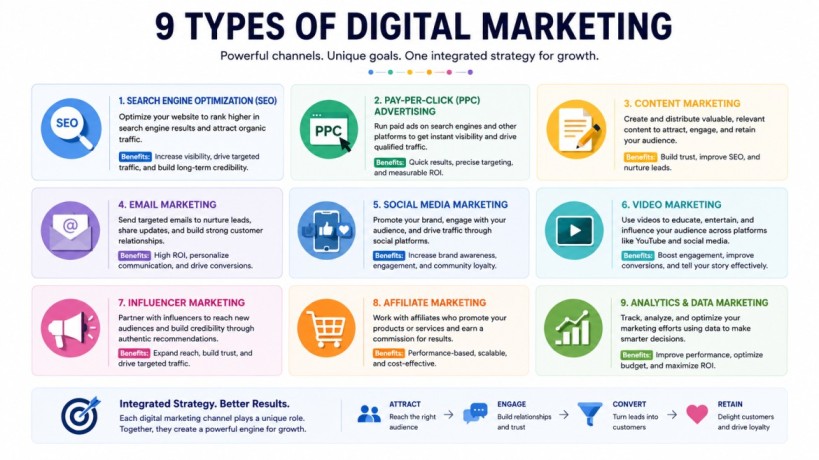
9 Types of Digital Marketing
Search Engine Optimization (SEO)
SEO is the process of optimizing your website so it ranks higher in Google Search (and other search engines) for keywords your target audience types in.
When someone searches “best CRM software” or “digital marketing agency near me,” SEO determines whether your page appears on page 1 or page 10. Over 90% of searchers never go past the first page.
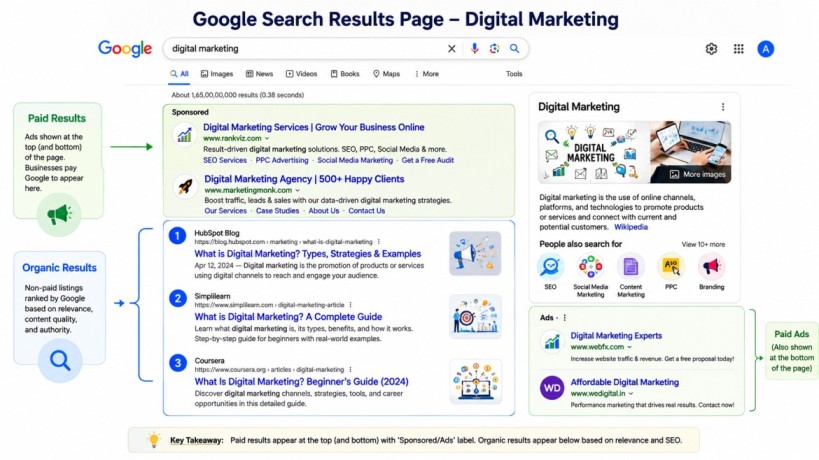
SEO has three main pillars:
- Technical SEO — Site speed, mobile-friendliness, crawlability, Core Web Vitals
- On-Page SEO — Keyword optimization, title tags, meta descriptions, internal linking
- Off-Page SEO — Backlinks, brand mentions, domain authority
SEO drives organic traffic — visitors who found you without you paying for the click. It’s the highest-ROI long-term digital marketing channel. A page that ranks #1 on Google can receive thousands of free visits monthly, for years.Best Digital Marketing Tools
Tools: Google Search Console, Ahrefs, Semrush, Yoast SEO, RankMath
📌 Go deeper: Complete SEO Guide for Beginners | Keyword Research Guide
Pay-Per-Click Advertising (PPC)
PPC is paid digital advertising where you pay each time someone clicks your ad. Google Ads is the dominant PPC platform, showing text ads at the top of search results for keywords you bid on.
PPC delivers instant visibility — unlike SEO which takes months to build. You can launch a Google Ads campaign today and appear at the top of Google Search by tomorrow.
Key PPC concepts:
- CPC (Cost Per Click) — What you pay each time someone clicks
- Quality Score — Google’s rating of your ad relevance and landing page quality (higher score = lower CPC)
- ROAS (Return on Ad Spend) — Revenue generated per dollar spent on ads
PPC works best when combined with a high-converting landing page and strong offer. Sending paid traffic to a weak page is like pouring water into a leaky bucket.
Platforms: Google Ads, Microsoft Ads (Bing), Meta Ads, LinkedIn Ads
📌 Go deeper: Google Ads Guide for Beginners
Content Marketing
Content marketing is the creation and distribution of valuable, relevant content to attract and retain a clearly defined audience — without directly pitching your product.
It works on a fundamental principle: help people first, sell second. When you consistently solve your audience’s problems through blog posts, guides, videos, podcasts, and infographics, you build trust. That trust converts readers into leads, and leads into customers.
Content marketing fuels SEO (Google needs content to rank), supports email marketing (newsletters need content), and feeds social media (posts need content). It’s the backbone of almost every digital marketing strategy.
Content types: Blog posts, long-form guides, case studies, infographics, ebooks, white papers, podcasts, newsletters
📌 Go deeper: Content Marketing Strategy Guide
Social Media Marketing
Social media marketing involves using platforms like Instagram, Facebook, LinkedIn, TikTok, and X (Twitter) to build brand awareness, engage your audience, and drive traffic or conversions.
It operates in two modes:
- Organic social — Free posting, community building, engagement, stories, and reels
- Paid social (Meta Ads) — Highly targeted paid campaigns using detailed audience data
Platform strengths:
- Facebook — Largest reach, best for lead generation and retargeting
- Instagram — Visual-first, strong for lifestyle brands, fashion, food, travel
- LinkedIn — B2B marketing, professional services, recruiting
- TikTok — Short-form video, massive reach for younger audiences
- YouTube — Long-form video, search-based discovery, strong SEO potential
- Pinterest — Visual search, strong for e-commerce, home decor, recipes
Social media marketing excels at brand awareness and community building. Direct sales conversions typically happen after multiple touchpoints.
📌 Go deeper: Social Media Marketing Guide
Email Marketing
Email marketing is the process of sending targeted messages to a list of subscribers to nurture relationships, promote content, and drive conversions.
It consistently delivers the highest ROI of any digital marketing channel — with studies showing an average return of $36–$42 for every $1 spent.
Why email works:
- You own your list (unlike social media followers)
- Direct access to the inbox — no algorithm filtering your reach
- Highly personalized and segmented messaging
- Automated sequences work 24/7
Core email marketing flows every business needs:
- Welcome sequence (new subscribers)
- Lead nurture sequence (educate → build trust → offer)
- Abandoned cart email (e-commerce)
- Post-purchase onboarding
- Re-engagement campaign (inactive subscribers)
Tools: Mailchimp, ConvertKit, ActiveCampaign, Klaviyo, Brevo
📌 Go deeper: Email Marketing Guide for Beginners
Affiliate Marketing
Affiliate marketing is a performance-based model where you pay partners (affiliates) a commission for driving sales or leads to your business. Affiliates promote your product through their blogs, YouTube channels, social media, or email lists.
From the affiliate’s perspective, it’s a way to earn passive income by recommending products you use and trust.
From the merchant’s perspective, it’s low-risk: you only pay when a conversion happens.
Amazon Associates, ShareASale, and Impact are major affiliate networks. Many SaaS companies (hosting providers, email tools, course platforms) run their own affiliate programs.
Influencer Marketing
Influencer marketing involves partnering with people who have an engaged following in your niche to promote your brand or product.
It works because audiences trust recommendations from people they follow more than ads from brands they don’t know. Influencer marketing leverages that trust.
Influencer tiers:
- Nano (1K–10K) — Highest engagement rates, affordable, niche audiences
- Micro (10K–100K) — Strong niche authority, cost-effective
- Macro (100K–1M) — Wider reach, higher cost
- Mega/Celebrity (1M+) — Mass awareness, very expensive
Micro-influencer campaigns often outperform mega-influencer campaigns in conversion rate because of stronger audience trust and relevance.
Video Marketing
Video is the dominant content format of 2026. YouTube is the world’s second-largest search engine. Short-form video (Reels, TikTok, YouTube Shorts) has become the fastest way to build brand awareness.
Why video marketing works:
- Builds personality and trust faster than text
- Demonstrates products in action
- Improves time-on-page (boosting SEO signals)
- YouTube videos rank in Google Search, giving dual visibility
Video types: Product demos, explainer videos, tutorials, testimonials, behind-the-scenes, live streams, webinars
Even a smartphone and decent lighting can produce effective marketing videos. Authenticity often outperforms production value on social platforms.
Mobile Marketing
Mobile marketing encompasses any digital marketing effort targeting users on smartphones and tablets — which now account for over 60% of global web traffic.
Mobile marketing channels:
- Mobile-optimized websites and landing pages
- SMS and WhatsApp marketing
- Push notifications (app or browser-based)
- Mobile ads (Google, Meta, in-app)
- App store optimization (ASO)
Mobile-first design isn’t optional — Google’s ranking algorithm prioritizes mobile-friendly sites, and most social media consumption happens on mobile.
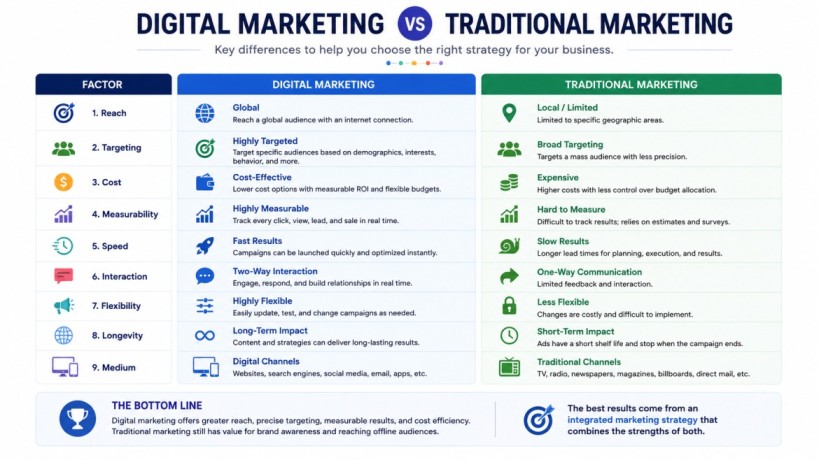
Digital Marketing vs Traditional Marketing
| Factor | Digital Marketing | Traditional Marketing |
|---|---|---|
| Reach | Global, targeted | Local/regional, broad |
| Cost | Low to medium | Medium to very high |
| Measurability | Precise (clicks, conversions, ROI) | Difficult to track |
| Targeting | Demographic, behavioral, interest-based | Limited targeting |
| Speed | Campaigns launch in hours | Weeks to months |
| Engagement | Two-way (comments, shares, replies) | One-way broadcast |
| Flexibility | Adjust in real time | Fixed once published |
| Examples | SEO, PPC, email, social media | TV, radio, print, billboards |
Benefits of Digital Marketing
1. Global reach with local precision. A bakery in Kathmandu can target people searching for “birthday cakes in Thamel” while a SaaS company targets prospects in 30 countries simultaneously.
2. Cost-effective. SEO and content marketing build compounding returns. A blog post published today earns traffic for years. Social media accounts are free to create. Entry-level PPC budgets start at a few dollars per day.
3. Measurable and data-driven. Google Analytics 4 shows you exactly which channels drive revenue, which content converts, and where your funnel leaks. No guessing.
4. Personalization at scale. CRM systems and email marketing tools let you send different messages to different customer segments automatically — based on behavior, purchase history, and lifecycle stage.
5. Higher engagement. Unlike TV ads people skip, content marketing attracts people actively seeking information. Engaged audiences convert at dramatically higher rates.
6. Competitive advantage. Small businesses can outrank and out-market larger competitors with smarter strategy. Budget isn’t the only factor — quality, relevance, and consistency matter.
7. Works 24/7. Your SEO-optimized blog, automated email sequences, and landing pages generate leads while you sleep.
Real-World Example of Digital Marketing
Let’s walk through how a fictional SaaS company — TaskFlow, a project management tool — uses digital marketing to acquire customers.
Step 1 — Content + SEO (TOFU) TaskFlow publishes a blog post: “How to manage remote teams more effectively.” Optimized for a keyword with 8,000 monthly searches, it ranks on page 1 of Google Search within 3 months. It earns 2,400 organic visits per month — free, recurring.
Step 2 — Lead Magnet (Capture) The blog post offers a free download: “Remote Team Productivity Toolkit.” Readers enter their email to download it. TaskFlow adds 120 new email subscribers per month from this one post.
Step 3 — Email Nurture Sequence (MOFU) New subscribers receive a 5-email sequence over 10 days: tips on remote team management, a case study, a product walkthrough video, and a comparison guide. By email 5, they’ve consumed enough content to trust TaskFlow.
Step 4 — Retargeting Ads (BOFU) Visitors who read the blog but didn’t sign up see Meta Ads and Google Display ads offering a 14-day free trial. Retargeting audiences convert 3–5x higher than cold audiences.
Step 5 — Free Trial → Paid (Close) Trial users receive an onboarding email sequence. A targeted in-app message on day 10 (“Your trial ends in 4 days — upgrade to keep your projects”) converts 22% to paid plans.
Step 6 — Retention + Advocacy Monthly newsletter, feature update emails, and a referral program keep customers engaged and bring in new leads via word-of-mouth.
Result: A self-sustaining customer acquisition engine that costs a fraction of traditional advertising.
Digital Marketing Channels Comparison
| Channel | Best For | Cost | Time to Results | Difficulty |
|---|---|---|---|---|
| SEO | Long-term organic traffic | Low (time investment) | 3–12 months | Medium–High |
| PPC (Google Ads) | Immediate leads/sales | Medium–High | Days | Medium |
| Content Marketing | Brand authority, SEO support | Low–Medium | 3–6 months | Medium |
| Social Media (Organic) | Brand awareness, community | Free | Slow | Low–Medium |
| Meta Ads | Targeted reach, lead gen | Low–High | Days | Medium |
| Email Marketing | Retention, conversions | Very Low | Immediate | Low |
| Influencer Marketing | Brand awareness, social proof | Variable | 1–4 weeks | Medium |
| Video Marketing | Trust building, SEO | Low–Medium | Variable | Medium |
| Affiliate Marketing | Performance-based sales | Commission only | Variable | Low (setup) |
Common Digital Marketing Mistakes
1. Starting without a strategy. Posting randomly on social media or running ads without a defined audience, goal, and funnel is wasted effort.
2. Targeting everyone. “Our target audience is everyone” means your message resonates with no one. Define your ideal customer precisely.
3. Ignoring mobile. Over 60% of web traffic is mobile. Slow, non-responsive pages destroy conversion rates and SEO rankings.
4. Treating each channel in isolation. SEO, content, email, and social media should work together as an integrated system, not as separate silos.
5. Not building an email list. Social media algorithms change. Ad costs rise. Your email list is an asset you own permanently.
6. Chasing vanity metrics. High follower counts and page views don’t pay bills. Focus on leads, conversions, and revenue.
7. Giving up too early. SEO takes months. Content marketing takes time to compound. Most businesses quit before the results arrive.
8. Skipping Conversion Rate Optimization (CRO). Doubling your conversion rate doubles your revenue without increasing traffic. Most businesses drive traffic but never optimize their landing pages.
Best Digital Marketing Tools
| Category | Tools |
|---|---|
| SEO | Ahrefs, Semrush, Google Search Console, RankMath, Yoast |
| Analytics | Google Analytics 4, Hotjar, Microsoft Clarity |
| PPC | Google Ads, Meta Ads Manager, Microsoft Advertising |
| Email Marketing | Mailchimp, ActiveCampaign, ConvertKit, Klaviyo |
| Social Media | Buffer, Hootsuite, Later, Sprout Social |
| CRM | HubSpot, Salesforce, Zoho CRM |
| Content/Design | Canva, Figma, Adobe Express |
| Video | Descript, CapCut, Loom |
| Landing Pages | Unbounce, Leadpages, Instapage |
| Automation | Zapier, Make (formerly Integromat) |
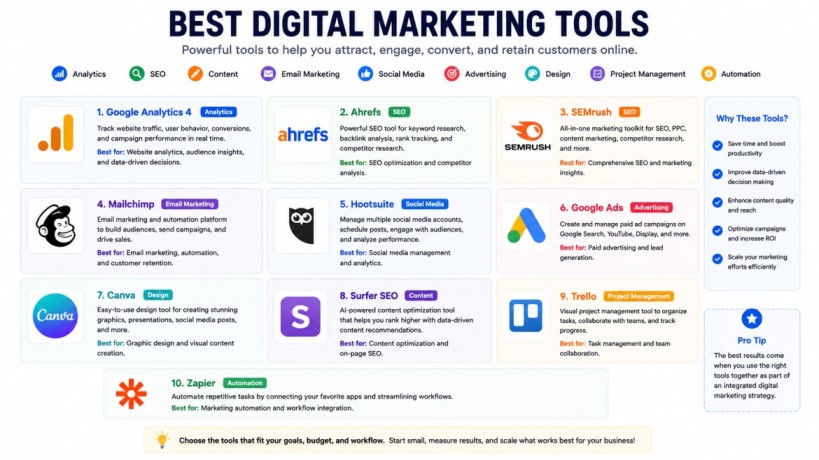
You don’t need all of these. A beginner stack: WordPress + RankMath + Google Analytics 4 + Google Search Console + Mailchimp + Canva covers 80% of what you need to start.
How to Start Digital Marketing as a Beginner
Follow this roadmap to build real skills without overwhelm:
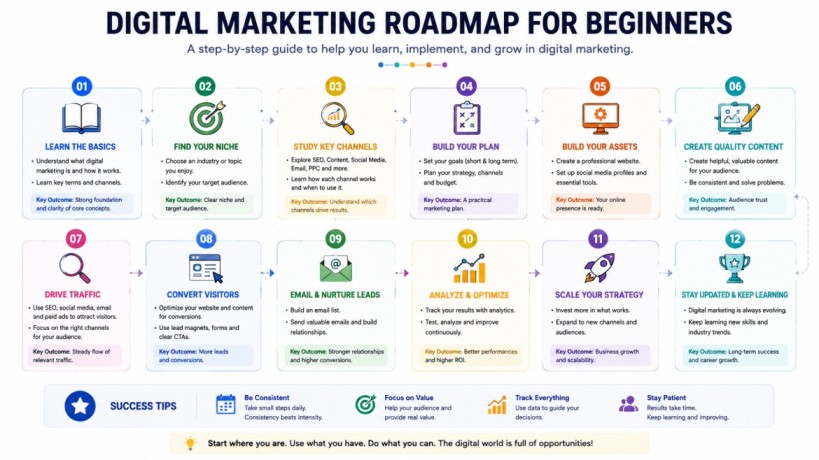
Month 1–2: Build your foundation
- Learn the basics of SEO (keyword research, on-page optimization, site structure)
- Set up Google Analytics 4 and Google Search Console on a website
- Create profiles on the platforms your target audience uses
Month 3–4: Create content
- Publish your first 10 blog posts targeting long-tail keywords
- Build an email list with a simple lead magnet
- Start a social media content calendar (2–3 posts per week)
Month 5–6: Learn paid advertising
- Run a small Google Ads or Meta Ads campaign ($5–$10/day)
- Study conversion rate optimization basics
- Analyze your data and adjust
Month 7–12: Specialize and scale
- Double down on the channel producing the best ROI
- Learn advanced SEO, email automation, or paid ads
- Consider a specialization: SEO specialist, PPC manager, content strategist
Free learning resources:
- Google Digital Garage (free Google certification)
- HubSpot Academy (free certifications)
- Ahrefs Academy
- Moz Beginner’s Guide to SEO
- YouTube channels: Neil Patel, Backlinko, Income School
Career Opportunities in Digital Marketing
Digital marketing is one of the fastest-growing career fields globally, with strong demand and competitive salaries.
| Role | Description | Avg. Salary (USD/yr) |
|---|---|---|
| SEO Specialist | Keyword research, on-page/technical SEO, link building | $45,000–$85,000 |
| PPC / Paid Ads Manager | Google Ads, Meta Ads, campaign optimization | $50,000–$95,000 |
| Content Strategist | Content planning, creation, and distribution | $50,000–$90,000 |
| Social Media Manager | Platform management, community, paid social | $40,000–$75,000 |
| Email Marketing Specialist | List management, automation, segmentation | $45,000–$85,000 |
| Digital Marketing Manager | Full-funnel strategy, team management | $65,000–$120,000 |
| Growth Marketer | Data-driven experimentation, funnel optimization | $70,000–$130,000 |
| Marketing Analyst | Data analysis, reporting, attribution | $55,000–$100,000 |
Is digital marketing a good career in 2026? Yes — demand consistently outpaces supply. Remote work is widely available. Freelancing and agency opportunities are abundant. You can start building portfolio-worthy experience with your own blog or by helping local businesses. No degree is required; demonstrated results matter most.
The Future of Digital Marketing and AI
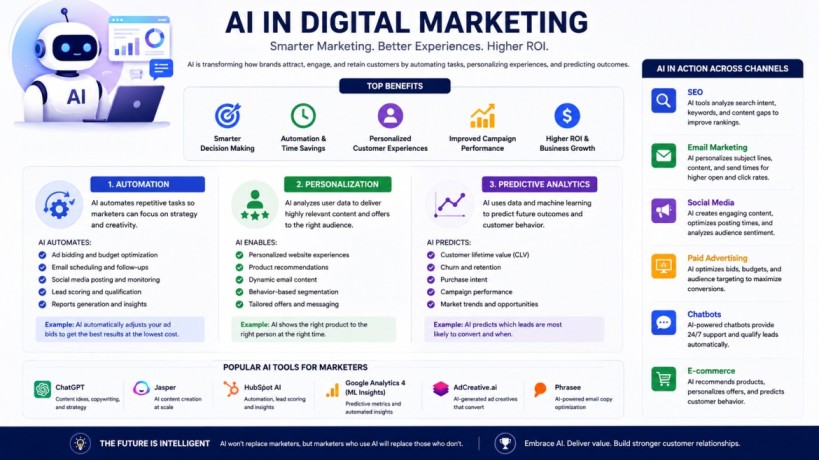
AI is reshaping every layer of digital marketing in 2026. Here’s what’s happening now and what’s coming:
AI-powered content creation. Tools like Claude, ChatGPT, and Jasper help marketers produce first drafts faster. But Google’s Helpful Content System rewards original, experience-based content — AI assists, but human expertise and unique perspective still win in SEO.
Predictive analytics. AI in platforms like Google Ads and Meta Ads automatically optimizes bids, audience targeting, and ad creative in real time — driving better ROAS than manual campaigns for most advertisers.
Conversational search. Google’s AI Overviews and Bing’s AI search are changing how search results look. Optimizing for featured snippets, structured data, and E-E-A-T (Experience, Expertise, Authoritativeness, Trustworthiness) is more important than ever.
Hyper-personalization. AI-driven CRM systems analyze behavior patterns to trigger the right email, offer, or ad at precisely the right moment in the customer journey — at scale.
Voice and visual search. Optimizing for voice queries and image-based search (Google Lens) represents a growing slice of organic traffic.
Short-form video dominance. TikTok, Instagram Reels, and YouTube Shorts continue to be the highest-reach format for brand awareness. AI-generated video is making production faster and cheaper.
Privacy-first marketing. With third-party cookies phased out, first-party data (your email list, CRM, and website data) is the most valuable marketing asset you can build.
The fundamentals — understanding your audience, creating valuable content, building relationships — don’t change. AI accelerates execution. The marketers who will win are those who combine strategic thinking with AI-assisted efficiency.
SEO vs PPC vs Social Media Marketing
| Factor | SEO | PPC | Social Media |
|---|---|---|---|
| Cost | Time investment (low cost) | Pay per click | Free (organic) |
| Speed | Slow (months) | Fast (days) | Medium |
| Longevity | Long-term results | Stops when budget stops | Algorithm-dependent |
| Trust | High (earned rankings) | Lower (marked as ad) | Medium |
| Best use | Sustainable traffic | Quick launches, testing | Brand awareness |
| Difficulty | High | Medium | Low–Medium |
| ROI timeline | 6–12 months | Immediate | Variable |
Frequently Asked Questions
What is digital marketing in simple words? Digital marketing is promoting your business online — through search engines, social media, email, websites, and apps — to attract customers, build brand awareness, and drive sales.
How does digital marketing work? It works by placing your brand in front of potential customers where they spend time online, then guiding them through a journey from awareness to purchase using targeted content, ads, and communications.
What are the 9 types of digital marketing? SEO, PPC advertising, content marketing, social media marketing, email marketing, affiliate marketing, influencer marketing, video marketing, and mobile marketing.
Is digital marketing a good career in 2026? Yes. Digital marketing skills are in high demand globally, remote work is widely available, salaries are competitive, and you can build a portfolio without a formal degree. Entry-level roles are accessible; experienced specialists and managers earn strong incomes.
Can I learn digital marketing without a degree? Absolutely. Many of the best digital marketers are self-taught. Free certifications from Google, HubSpot, and Meta, combined with hands-on practice, are more valued by employers than a general marketing degree.
How long does it take to learn digital marketing? You can learn the fundamentals in 3–6 months through free online resources. Getting practical experience and building a specialization takes 6–12 months. Becoming genuinely skilled in a specific channel (like SEO or paid ads) takes 1–2 years of real-world application.
What is the difference between SEO and digital marketing? SEO (Search Engine Optimization) is one channel within digital marketing. Digital marketing is the broader umbrella that includes SEO, paid ads, email marketing, social media, content marketing, video, and more.
Which digital marketing channel is best for beginners? Content marketing combined with basic SEO is the best starting point. It costs little, builds lasting assets, and teaches you audience understanding, keyword research, and writing — skills that apply to every other channel.
Final Thoughts
Digital marketing is not a single tactic — it’s an ecosystem of interconnected channels, tools, and strategies that work together to grow a business online.
The best starting point is always the same: understand your audience deeply, then show up where they are with content that genuinely helps them.
Start with one or two channels. Master them. Then expand. The businesses that fail at digital marketing usually try to do everything at once and do nothing well.
Whether you’re a beginner learning the foundations, a business owner building your first funnel, or a marketing professional expanding your skill set — the fundamentals covered in this guide give you the framework to build something that works.